
The Racial Equity and Implicit Bias Statewide Initiative at CDSS
When the California Department of Social Services (CDSS) set out to deepen its commitment to equity, leaders recognized both a powerful opportunity and a complex challenge. They aimed to drive culture change across a vast statewide system while honoring the distinct realities of California’s diverse counties. The question was not simply how to launch a statewide equity program, but how to build a durable system for change.
California’s response was the three-year Racial Equity and Implicit Bias (REIB) Statewide Initiative. CDSS partnered with Anavo to design and manage a multi-phase effort that balanced statewide vision with county-level ownership.
Project Information
Client: California Department of Social Services (CDSS)
Location: California, US
Project Duration: 3 years (2021–2024)
Focus Areas:
Equity Learning & Training
Curriculum Development
Strategic Program Design
Peer Learning
Leadership Development
Landscape Analysis
Client Type: Government / Public Social Services
REIB Highlights
Building on a foundation of county engagement and inclusive collaboration, the Initiative successfully reached all 58 counties, engaged more than 11,700 participants, and delivered 419 workshops, webinars, and learning collaboratives across the state.
Over three years, the California Department of Social Services (CDSS) partnered with Anavo to design and implement the Racial Equity and Implicit Bias (REIB) Statewide Initiative, a series of learning programs fostering more equitable and inclusive practices within the agency’s large and diverse workforce. The Initiative delivered customized and inclusive learning experiences for programs and partners that support low-income Californians across all counties.
Anavo’s role was to create the structure that made this work possible—designing and managing the operational, relational, and learning infrastructure that enabled thousands of participants to engage meaningfully in advancing equity.
Initiative Architecture
Anavo served as the architect of the Initiative, designing the systems that allowed a complex, multi-year statewide effort to function effectively at scale. We built the operational infrastructure supporting strategy, logistics, learning design, and collaboration across partners. Continuous feedback loops were embedded across every stage—from research and curriculum development to piloting, delivery, and refinement—allowing the Initiative to evolve in real time and remain responsive to county needs. By managing the “work behind the work,” we enabled CDSS and partners to focus on advancing equity rather than the mechanics of delivery.
From the beginning, the Initiative was designed with sustainability in mind. Anavo focused on building internal capacity within CDSS and creating systems that would outlast the life of the project. This included developing tools, processes, and relationships that could continue supporting equity work beyond the Initiative’s funding cycle. Rather than focusing solely on participation numbers, the Initiative emphasized practices and structures that embed equity into everyday work.
County Outreach and Engagement
The success of the REIB Initiative depended on county participation. With 58 counties beginning from different places in their equity journeys, CDSS needed an approach that could invite engagement without imposing a one-size-fits-all mandate.
Landscape Analysis
Anavo began outreach by conducting a statewide landscape analysis, interviewing county staff and gathering insights about existing practices, needs, and concerns. These early conversations signaled that the Initiative was not a top-down directive but a genuine effort to listen and learn. The relationships built during this phase established the trust that would sustain the Initiative over the following three years.Sustained County Communication
County trust remained central to the Initiative’s success throughout the Initiative. Anavo assigned dedicated county liaisons who partnered with counties throughout the Initiative. Through ongoing dialogue, these liaisons introduced workshops and resources as practical tools that counties could apply immediately in their work. Rather than asking counties to conform to a single model, we met them where they were—offering flexibility, multiple entry points, and consistent communication throughout the process.
Vendor Collaborative and Cross-Functional Workgroups
The REIB Initiative was built through collaboration across a broad network of partners, including counties, community organizations, universities, small businesses, and independent facilitators. To coordinate this work, Anavo designed and convened a vendor collaborative that aligned REIB partners around shared goals, clear roles, and a peer-based approach to curriculum development. The collaborative brought together content experts who worked together to translate equity concepts into practical approaches that counties could adapt within their own programs and communities.
In parallel, we supported cross-functional workgroups composed of county managers and supervisors, employee union representatives, Tribal TANF leaders, program participants, CDSS Office of Equity, and CalFresh food advocates. These workgroups allowed partners to contribute meaningfully while maintaining momentum across the Initiative.
Igniting Change
Spotlighting Our Approach
REIB Learning Experiences
-
To build awareness and engagement among counties, the Initiative hosted eight webinars between May and October 2023. The webinars featured subject-matter experts and practitioners who contributed to a shared understanding of equity-focused practice in county welfare systems. Topics included foundational REIB concepts, the role of California’s social safety net in promoting equity, and perspectives on serving Native American participants.
These sessions served as an accessible entry point for county staff, introducing key concepts and preparing participants for deeper learning through workshops and collaborative leadership spaces.
-
Anavo worked with the REIB Vendor Collaborative to facilitate a suite of workshops tailored for county welfare department staff at all levels. Workshops were delivered in multiple formats—including in-person sessions and instructor-led virtual classes—to meet the needs of counties across the state. These sessions created safe spaces for learning, dialogue, and reflection, with content adapted to different county and regional contexts.
Key workshop topics included:
Practicing trauma-informed techniques in everyday work
Addressing microaggressions in the workplace
Using data to understand local inequities
Building psychological safety within teams
Leadership tools for managers and supervisors
Train-the-Trainer sessions to support ongoing learning within counties
Together, the workshops focused on translating equity concepts into practical skills that staff could apply in their daily work.
-
Anavo approaches leadership as something that exists at every level of an organization, while recognizing that positional leaders shape culture, policy, and the pace of change.
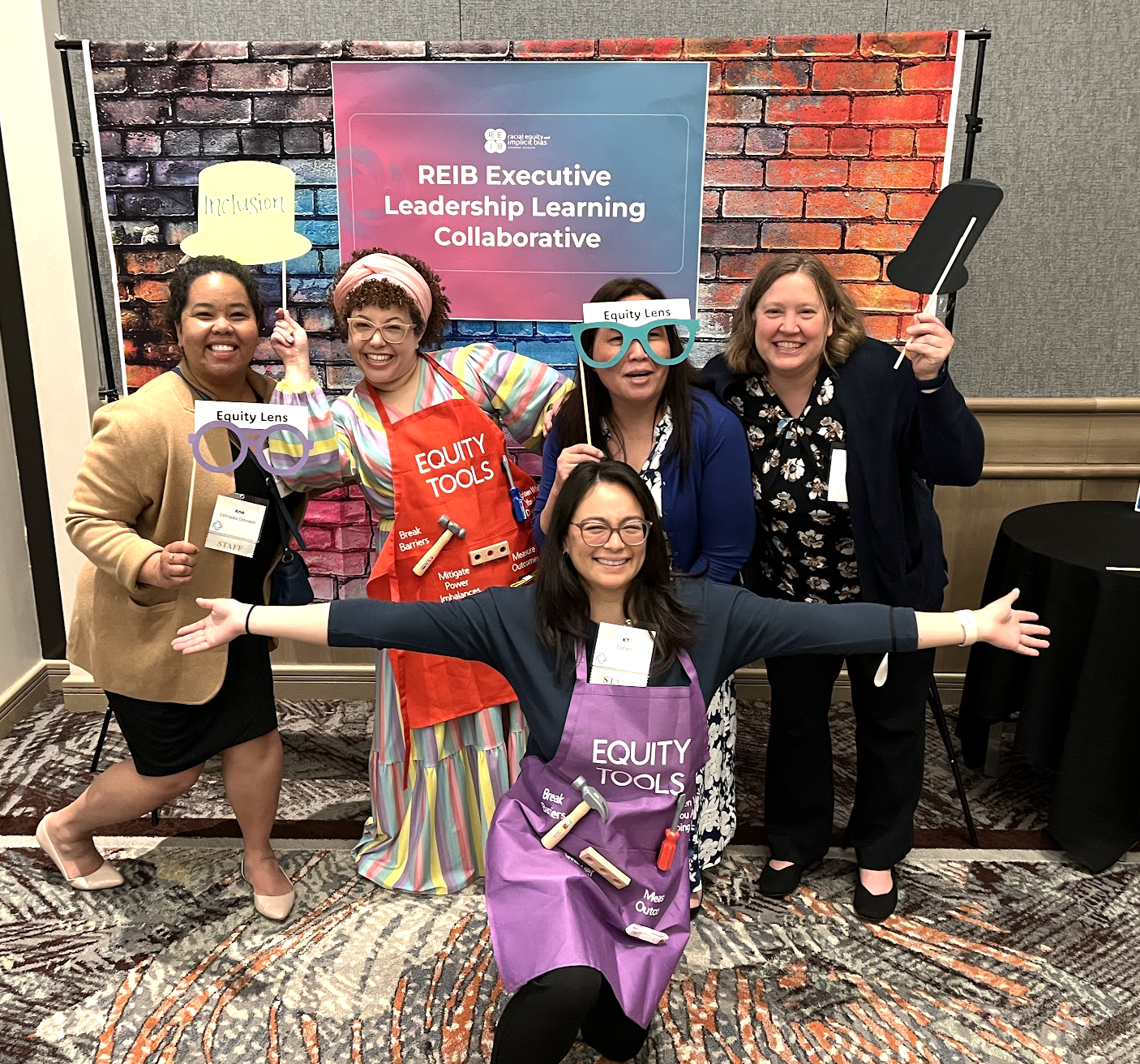
Within the REIB Initiative, this philosophy informed the creation of the Executive Leadership Learning Collaborative (ELLC)—a series of intensive learning experiences for senior county leaders designed to build shared language, practical tools, and accountability for advancing equity within their departments. Through a combination of virtual sessions, a two-day in-person convening, and follow-up conversations, leaders engaged in facilitated dialogue, peer learning, and applied planning focused on translating equity commitments into everyday leadership practice.
ELLC supported leadership to:
Connect equity concepts to policy, management, and operational decisions
Reflect on how leadership behaviors shape organizational culture and psychological safety
Build shared accountability and practical strategies for sustaining culture change across counties
Design & Delivery
-
Learning within REIB was intentionally designed as a system. Anavo led the overall learning design while collaborating with partners to develop experiences that supported different roles, learning styles, and levels of readiness across counties.
Key features of the learning design included:
Practical application of equity concepts, translating principles into approaches counties could adapt within their own contexts.
Iterative curriculum development, informed by early landscape analysis, co-development with partners in workgroups, pilot sessions, and continuous feedback from participants and facilitators.
Peer learning and shared reflection, creating opportunities for participants across counties and roles to learn with and from one another.
These sessions served as an accessible entry point for county staff, introducing key concepts and preparing participants for deeper learning through workshops and collaborative leadership spaces.
-
To support learning at scale, our team designed, created, and maintained the REIB Hub, a shared digital infrastructure where participants could:
Discover and register for workshops and learning sessions
Access resources and tools
Continue their learning journey over time
The REIB Hub was a reliable backbone for statewide engagement. Our team focused on creating an accessible and intuitive platform that could support thousands of participants. This included ensuring ADA compliance and language access, designing clear onboarding pathways, and providing responsive participant support.
-
Anavo served as the operational anchor of the Initiative, ensuring that the systems supporting learning, participation, and coordination functioned smoothly at statewide scale.
Participant Experience and Digital Platform Support: Our team continuously maintained the REIB Hub—testing site accounts, updating pages as content evolved, and responding quickly to participant questions.
Data Analysis: At the same time, we managed the Initiative’s data systems and reporting infrastructure. Initiative data was translated into detailed reports that tracked participation, session reach, and engagement across counties. These insights provided CDSS with a clear view of progress statewide and informed strategic decisions about where to focus future resources.
By serving as a trusted day-to-day partner, we ensured the Initiative had the systems, tools, and processes needed to sustain impact.
Fueling Impact
All 58 counties reached
Over 11,700
participants engaged
419 total learning sessions delivered
Core principles guided every stage of the work: meeting counties where they were, centering lived experience, building lasting capacity, and creating safe spaces for learning and reflection.
The impact was felt at multiple levels.
Organizational impact:
Participants reported feeling better equipped to apply new tools immediately in their work with families. Many shared that the experience helped them reconnect with empathy and remember why they entered public service.Systems impact:
Sixteen counties incorporated REIB training into their CalWORKs System Improvement Plans, embedding equity into long-term strategy. Leaders described the Initiative as a catalyst for aligning policies and practices with organizational values.Statewide impact:
By bringing counties together in shared learning, the Initiative fostered a common language around equity and created networks of support across jurisdictions.
The REIB Statewide Initiative demonstrates what becomes possible when state leaders, county staff, and communities co-create change within a strong, supportive infrastructure.
By building the systems that enabled listening, collaboration, and learning at scale, Anavo helped create the conditions for meaningful transformation.